By Jeff Richmond
How Software Development Has Changed Since 2000: From Punch Cards to Vibe Coding
March 2026
Software development today looks nothing like it did when I started exploring the field around the turn of the millennium. Back then, shipping code felt like launching a rocket-meticulous, expensive, and unforgiving. Today, I can describe an app in plain English, chat with an AI, and watch a working prototype appear in minutes. This is the story of how we got here.
The 2000 Baseline
In 2000, software development was manual, rigid, and hardware-bound. The dominant methodology was Waterfall: write exhaustive specs, code for months, test everything at the end, then deploy. Release cycles stretched 12-18 months.
Tools were basic:
- Desktop IDEs like Visual Studio or Eclipse
- Version control with CVS or SVN
- On-premise servers you physically racked and maintained
- Languages like C++, Java, early PHP, and ASP
The web was mostly static pages or clunky dynamic ones. Mobile? Non-existent in any meaningful way. Debugging meant printing stack traces or attaching a hardware debugger. Deploying often involved burning a CD or using FTP in the middle of the night. The barrier to entry was sky-high. "Real programmers" wrote everything by hand. Open source existed but was niche. Teams were siloed-developers threw code "over the wall" to operations teams.
Foundational Shifts (2000s-2010s): Process, Collaboration, and the Cloud
The Agile Manifesto dropped in 2001 and changed everything. Suddenly we had Scrum, Kanban, user stories, and iterative development. Stand-ups replaced month-long status reports. Feedback loops shrank from months to weeks.
Git arrived in 2005, and GitHub (2008) turned version control into a social network. Open source exploded. Anyone could fork, contribute, and learn in public.
Then came the cloud. AWS launched in 2006, followed by Azure and GCP. Infrastructure as code (Terraform, CloudFormation) replaced racking servers. DevOps emerged to tear down the dev-vs-ops wall with CI/CD pipelines, automated testing, and one-click deployments.
Mobile exploded: iPhone in 2007, Android in 2008. Responsive design, single-page apps (Angular, React, Vue), and REST/GraphQL APIs became table stakes. By the end of this era, software was no longer locked to a desk-it lived in the cloud, updated continuously, and reached billions of pockets.
Modernization Wave (2010s-Early 2020s): Abstraction and Scale
We abstracted even further:
- Containers and orchestration: Docker (2013) and Kubernetes turned infrastructure into code you could version and reproduce perfectly.
- Microservices replaced monoliths.
- Serverless (AWS Lambda, etc.) let us forget servers entirely.
- Low-code/no-code platforms appeared for non-engineers.
- Jamstack, Next.js, and API-first architectures made frontend/backend separation cleaner than ever.
Observability, A/B testing, real-time analytics, and data pipelines became standard. Remote work-especially post-2020-became the default. Teams shipped faster, scaled globally, and focused on business logic instead of infrastructure plumbing.
The AI Revolution (Mid-2020s Onward): From Code Completion to Conversational Development
The real game-changer arrived with large language models.
Early AI-assisted tools like GitHub Copilot (2021) felt like "autocomplete on steroids." They suggested whole functions and cut boilerplate dramatically.
Then came AI-assisted chats: tools like ChatGPT, Claude, Cursor, and Claude Code turned the IDE into a conversation. I now debug, refactor, document, and pair-program with an AI that understands my entire codebase. Productivity jumped 2-3x for many tasks. Legacy code that used to take days to understand is now explained in seconds.
But the biggest mindset shift came in early 2025 when Andrej Karpathy coined "vibe coding".
There's a new kind of coding I call "vibe coding", where you fully give in to the vibes, embrace exponentials, and forget that the code even exists.
Vibe coding is high-level, conversational, and almost lazy in the best way. Instead of writing syntax, you describe the feeling or outcome:
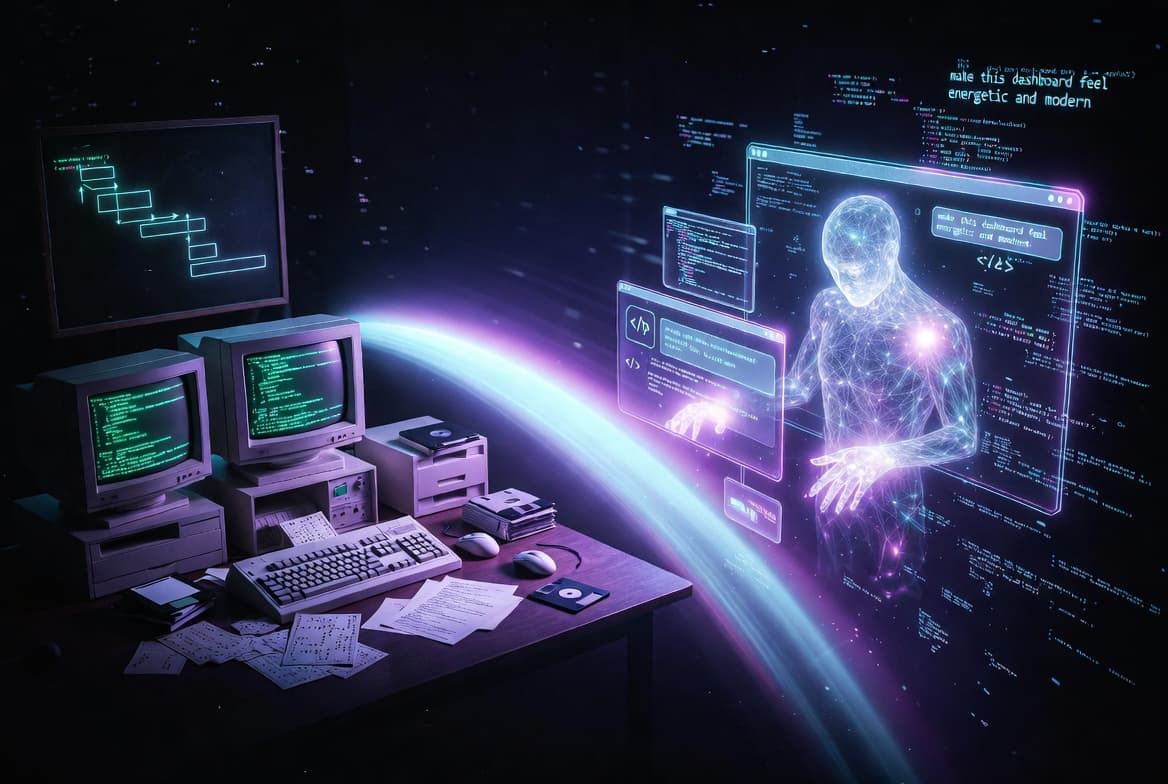
Make this dashboard feel energetic and modern, with smooth animations, dark mode by default, and real-time metrics that pop.
The AI (often using tools like Cursor Composer with voice input via SuperWhisper) generates, iterates, tests, and even deploys the code. You barely touch the keyboard. It's perfect for MVPs, internal tools, throwaway scripts, and rapid experimentation.
Tools enabling this today:
- Cursor + Claude Sonnet
- Replit Agents
- Bolt.new, Lovable, v0.dev
- Claude Code and similar agentic platforms
We've moved from line-by-line coding to orchestrating AI agents that do the heavy lifting.
Broader Impacts: Who Wins, Who Adapts
This evolution has democratized software creation:
- Designers, domain experts, and non-traditional developers can now ship real apps.
- Barrier to entry has plummeted.
- Smaller teams (or even solo founders) ship at speeds that used to require 20-person engineering organizations.
Skills have shifted. Raw syntax knowledge matters less. What matters now:
- Prompt engineering
- System design and architecture
- Critical evaluation of AI output
- Product taste and user empathy
Team dynamics changed too. Emphasis moved from coding volume to orchestration, taste, and rapid iteration. Startups move faster and cheaper than ever.
Challenges, Criticisms, and the Road Ahead
It's not all sunshine.
Vibe coding and AI chats can create technical debt. AI sometimes hallucinates, introduces subtle security flaws, or generates code you don't fully understand. "It works but I don't know why" is a real risk.
Over-reliance is dangerous. Code quality, ownership, and long-term maintainability still require human judgment-especially for complex systems, compliance, or high-stakes applications.
Job market impacts are real. Demand is rising for senior engineers who can guide AI effectively, while some junior roles focused purely on routine coding are shrinking. New roles like "AI-native engineer" or "agentic orchestrator" are emerging.
Ethical questions remain: IP ownership of AI-generated code, regulatory oversight, and the environmental cost of massive GPU clusters. Looking ahead: agentic swarms, multimodal coding (voice + vision + diagrams), and potentially fully autonomous software factories. Human judgment, creativity, and empathy will remain irreplaceable.
Conclusion: The Core Remains-But the Tools Are Magical
From rigid Waterfall processes and manual server management in 2000 to fluid, AI-augmented vibe-driven creation in 2026, the journey has been remarkable. The fundamental job-solving real problems for real people-hasn't changed. What has changed is how accessible, fast, and fun it has become.
Software development is more democratic and creative than ever. Whether you're a veteran who remembers burning CDs or a newcomer jumping straight into Cursor, the tools are waiting.
Try it yourself this week. Open Cursor or Claude, describe your next side project in plain English, and let the conversation flow. You might be surprised where the vibe takes you.
If this resonated with you, get in touch through the Contact page. I'd love to hear from you.
Related reading: How the AI Debate Arena Was Built & How IdealMatchAI Was Built.